

By Grace Chang
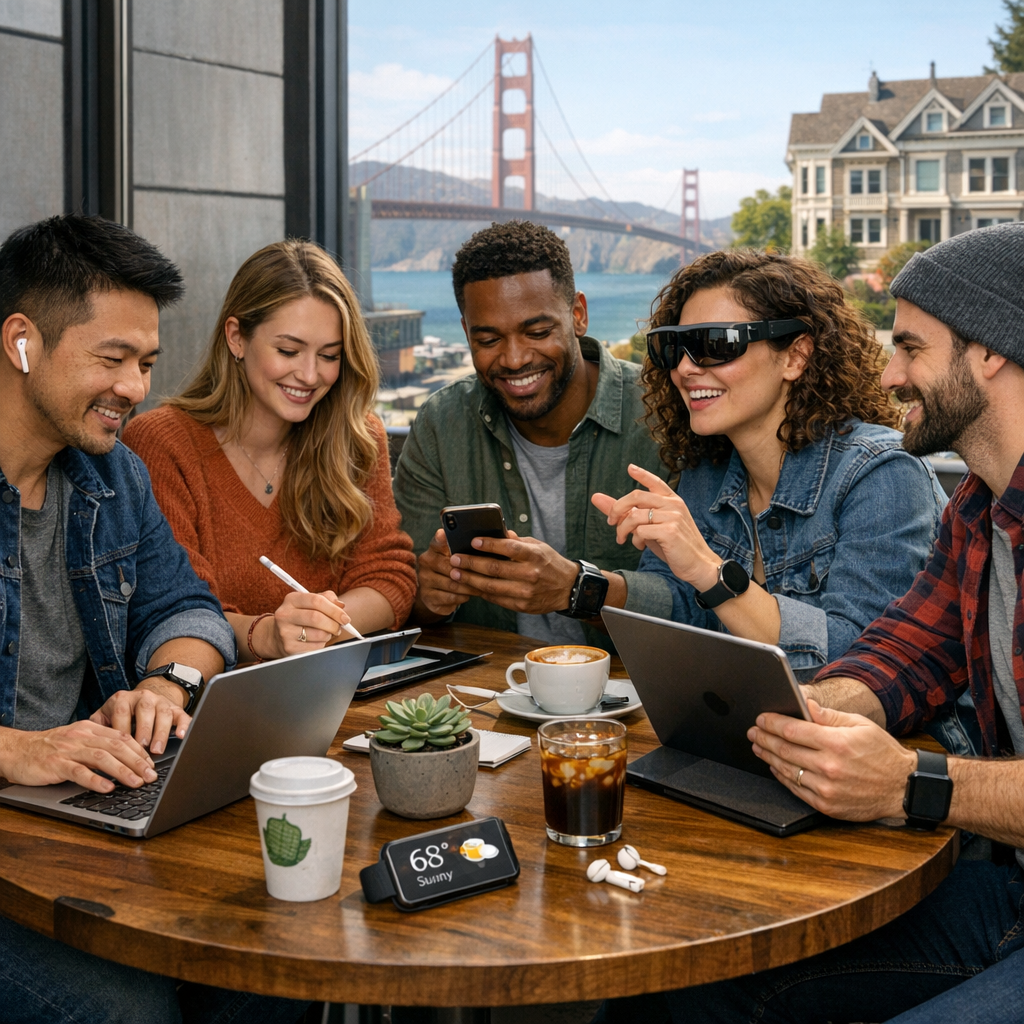
Artificial intelligence isn’t just for labs anymore—it’s woven into the everyday in San Francisco, from voice-activated hardware to data concerns in smart homes. Here’s how AI startups and big tech are changing daily rhythms for people who live here.
Small Devices, Big Impact
One startup based in San Francisco is developing “Button Computer,” a tiny wearable device you clip to your shirt to talk to an AI assistant—no phone needed. It responds instantly, blurring the line between smartphone and personal voice interface. It’s part of a wave of hardware designed to make AI more seamless and ambient.
Meanwhile, at demo events across the city, innovators are showing off AI agent tools that handle enterprise tasks, “generative fashion intelligence” that suggests designs, and assistive robotics aimed at healthcare settings. These gadgets and services are already finding their way into workplaces and homes.
Startups Scattered Through Neighborhoods
In past years, SoMa and the Financial District were the hotspots for tech firms. That’s changing. AI futures are now being built in Hayes Valley (nicknamed “Cerebral Valley”), the Mission, Dogpatch, Potrero Hill, and even parts of the Richmond and Sunset districts. Repurposed storefronts and converted flats are hosting small AI labs and teams.
This neighborhood spread is driven by cost and lifestyle: cheaper rents, shorter commutes, and closer ties to the local community. Smaller teams are scaling, and they want flexible workspaces more than elite high-rises.
Trust, Privacy, and Trade-Offs
As AI diffuses into daily life, many people are asking what they’re giving up for the convenience. A recent user study of “GenAI smartphones” revealed that people feel uneasy when they realize how much personal data is collected—continuously, often non-transparently, and sometimes without clear control over how it’s stored or used.
In the broader U.S., nearly half of adults now say they use AI chatbots, but most report concerns about AI’s speed and effect on privacy. Many want to see stronger transparency from companies—what gets collected, who sees it, how long it’s stored.
How much trust people place in AI differs wildly depending on purpose. Folks may be comfortable letting an AI schedule meetings or offer directions—but they draw sharp lines around emotional advice or exposure of sensitive medical or financial info.
What’s Ahead
- Expect more hybrid devices—voice-activated wearables, smart glasses, perhaps AI-enabled textiles—that respond to context without needing direct input.
- Startups will continue to grow outside of the downtown core, bringing more services closer to where people actually live.
- Regulation and corporate policy might finally catch up: clearer opt-outs, stronger default privacy protections, and standards for how AI systems store or explain their decisions.
AI is not a future phenomenon in San Francisco—it’s already part of subway rides, kitchen counters, workstations, and the air between coffee shops. With each device and each app, there’s a balance to be struck: the joy of instant convenience, and the responsibility of guarding what’s deeply personal.